
Smart Parent
Understanding Assessments: A Family's Guide to Evaluations
Assessments can feel endless, but they are often the documentation that protects access to therapies, education, healthcare, funding, and long-term supports.
Why They Matter, Why They Never Seem to End, and How They Help Secure the Services Your Loved One Needs
Welcome to the World of Assessments
If you're raising or caring for someone with a disability, you will quickly discover that assessments become part of everyday life.
From the time concerns first arise through adulthood, you may find yourself scheduling evaluations, completing questionnaires, attending appointments, gathering records, and meeting with professionals. It can feel overwhelming, sometimes like you're constantly proving that your loved one still needs the services they've always needed.
You're not imagining it. For many families, assessments become one of the biggest ongoing responsibilities of caregiving.
The good news is that understanding why assessments exist and how they work can make the process much less intimidating.
Why Are Assessments So Important?
Think of an assessment as a snapshot of your loved one's current abilities, challenges, strengths, and support needs.
They help answer questions like:
- What can this person do independently?
- Where do they need support?
- What therapies would help?
- What medical care is needed?
- What educational services are appropriate?
- What funding or benefits are available?
These evaluations provide the documentation professionals use to make informed decisions and develop individualized plans of care. Without current assessments, it becomes much harder to advocate for appropriate services.
Assessments Are the Foundation of Services
One of the most important things families learn is this: assessments are often the documentation that keeps services in place.
Schools, insurance companies, Medicaid, state disability agencies, therapy providers, and medical specialists all rely on current evaluations to determine eligibility and continued need.
Even when a disability is lifelong, agencies often require updated documentation to demonstrate that support is still necessary.
Current assessments may be required to:
- Maintain therapy services
- Renew insurance authorizations
- Continue Medicaid eligibility
- Qualify for waiver programs
- Update IEPs and school services
- Access residential supports
- Receive adaptive equipment
- Apply for adult disability services
- Support guardianship and future planning
Without updated evaluations, services can be delayed, reduced, or interrupted, not because your loved one's needs have disappeared, but because the required documentation is no longer current.
Why Does It Feel Like We're Always Being Evaluated?
This is one of the most common questions families ask. The answer is simple: needs change over time.
Children grow. Skills develop. Medical conditions evolve. Educational expectations increase. Support systems change.
As a result, agencies periodically require updated information to ensure services remain appropriate. While the process can feel repetitive, these evaluations help create a current picture of your loved one's needs and ensure they continue receiving the right level of support.
Different Systems Use Different Names
One of the most confusing parts of navigating disability services is that different professionals use different words for essentially the same process.
You may hear:
- Assessment
- Evaluation
- Reevaluation
- Screening
- Testing
- Examination
- Clinical Evaluation
- Diagnostic Evaluation
- Functional Assessment
- Needs Assessment
- Eligibility Assessment
- Psychological Testing
- Medical Evaluation
- Therapy Evaluation
- Independent Educational Evaluation (IEE)
- Functional Behavior Assessment (FBA)
- Adaptive Behavior Assessment
- Vocational Assessment
- Transition Assessment
- Medical Necessity Review
- Annual Review
- Recertification
- Redetermination
- Documentation Update
Although the names differ, they all serve a similar purpose: to understand your loved one's current needs and determine what services, supports, or funding they qualify for.
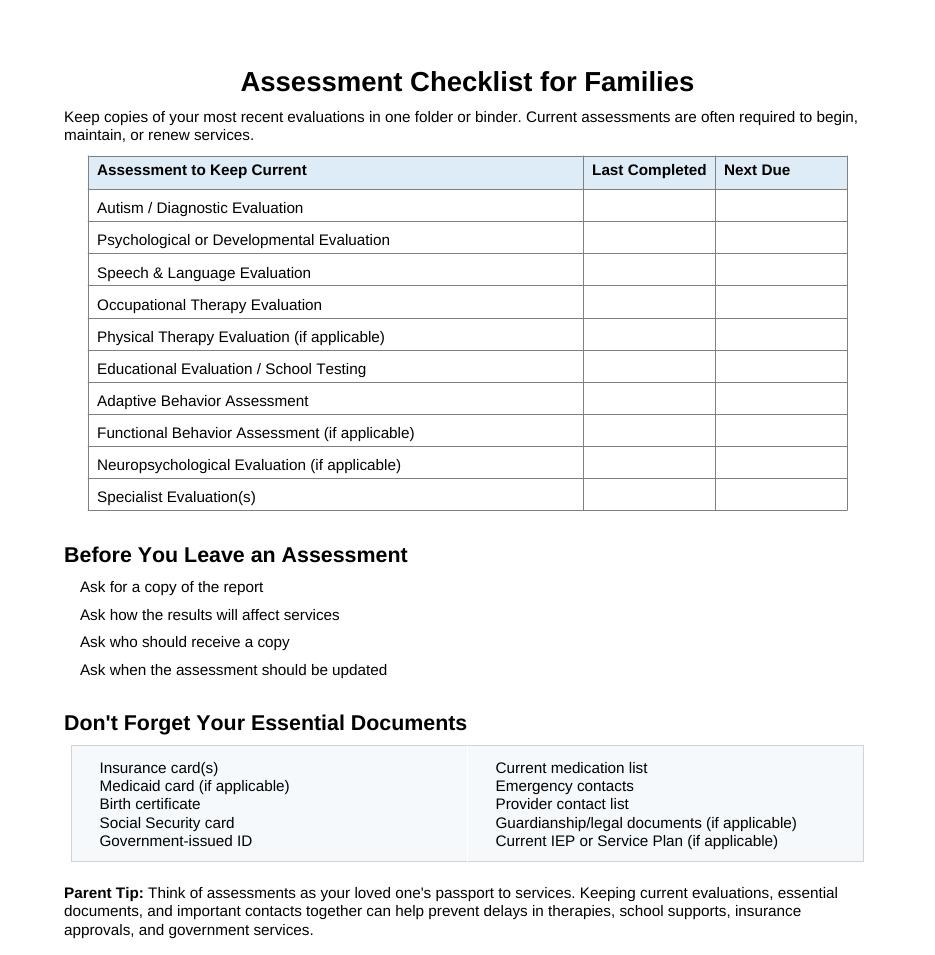
Assessment Checklist for Families
A one-page checklist to track which evaluations are current, what to ask before you leave an appointment, and the documents to keep on hand.
Who Requests Assessments?
Many different organizations may require evaluations, including:
- Medical providers
- Schools
- Early Intervention programs
- Therapy providers such as speech, OT, PT, and ABA
- Insurance companies
- Medicaid
- State disability agencies
- Guardianship courts
- Residential programs
- Vocational programs
Each system has its own requirements and timeline, which is why families often juggle multiple evaluations at the same time.
Common Types of Assessments
Medical Assessments
Evaluate overall health, medical conditions, medications, specialists, and treatment needs.
Developmental Evaluations
Measure developmental progress across cognitive, motor, language, social, and adaptive skills.
Autism Evaluations
Used to diagnose autism or reassess developmental functioning and support needs.
Psychological Assessments
Evaluate learning, cognition, emotions, behavior, IQ, and mental health.
Neuropsychological Evaluations
Provide an in-depth understanding of how the brain processes information, including memory, attention, executive functioning, and learning.
Educational Assessments
Determine academic strengths, learning needs, and eligibility for special education services.
Speech & Language Evaluations
Assess communication, language, articulation, AAC needs, and sometimes feeding or swallowing.
Occupational Therapy Evaluations
Focus on sensory processing, fine motor skills, daily living skills, handwriting, and independence.
Physical Therapy Evaluations
Assess strength, balance, coordination, mobility, endurance, and gross motor skills.
Behavioral Assessments
Help identify why behaviors occur and develop effective intervention plans.
Adaptive Behavior Assessments
Measure everyday life skills such as communication, self-care, safety, community participation, and independence.
Functional Assessments
Evaluate real-world abilities like dressing, cooking, transportation, hygiene, money management, and employment skills.
Vocational Assessments
Identify work interests, strengths, and the supports needed for employment.
Transition Assessments
Prepare students for adulthood by evaluating readiness for employment, education, independent living, and community participation.
Assistive Technology Evaluations
Determine whether devices or adaptive equipment can increase independence.
Residential Assessments
Evaluate support needs for residential living and long-term care planning.
A Lifetime of Assessments
Birth to Age 3
Early Intervention evaluations, developmental screenings, therapy assessments, autism evaluations, hearing and vision screenings.
Purpose: identify delays early and begin services.
Ages 3-5
Preschool special education evaluations, speech, OT, PT, psychological testing, adaptive assessments.
Purpose: determine eligibility for preschool services and build an educational plan.
School Years
Educational testing, IEP reevaluations, psychological evaluations, therapy reevaluations, behavioral assessments, assistive technology evaluations.
Purpose: ensure educational supports continue to meet changing needs.
Throughout Childhood
Medical specialists may recommend additional evaluations related to neurology, genetics, gastroenterology, psychiatry, sleep, nutrition, vision, hearing, and other health concerns.
Purpose: monitor health and adjust treatment plans.
Transition to Adulthood
Vocational assessments, transition planning, adaptive behavior evaluations, functional skills assessments, guardianship evaluations.
Purpose: prepare for employment, adult services, and independent living.
Adulthood
Medicaid reviews, waiver renewals, residential assessments, functional evaluations, behavioral reviews, medical necessity documentation, therapy reevaluations.
Purpose: maintain funding, therapies, residential services, and community supports.
Stay Organized
One of the best things you can do is build your own assessment library.
Keep copies of:
- Medical reports
- Psychological evaluations
- Educational testing
- Therapy evaluations
- IEPs
- Behavior plans
- Adaptive assessments
- Insurance approvals
- Eligibility letters
- Specialist recommendations
Many families keep both a digital folder and a physical binder. When a new provider asks for records, you'll have everything ready.
Questions to Ask During Any Assessment
Whenever an evaluation is recommended, ask:
- Why is this assessment needed?
- What information will it provide?
- How will it affect services?
- Will I receive a written report?
- Who should receive a copy?
- When should it be repeated?
- What recommendations will come from it?
Understanding the purpose behind each evaluation makes the process feel much more manageable.
Parent Tip
Create a simple calendar or spreadsheet listing important evaluations and when they are due for renewal. Scheduling reevaluations several months before deadlines can help prevent interruptions in services caused by expired documentation.
Remember...
An assessment is not a test your loved one has to pass. It is a tool to better understand who they are, what they do well, where they need support, and how professionals can help them thrive.
While the process can sometimes feel endless, every evaluation helps tell your loved one's story. Together, these assessments create a comprehensive picture that opens doors to therapies, educational opportunities, healthcare, community supports, funding, and a better quality of life.
A Final Thought
Think of assessments as your loved one's passport to services.
A diagnosis may last a lifetime, but the documentation supporting that diagnosis often needs to be updated throughout life. By keeping evaluations organized and current, you're not just completing paperwork. You are protecting access to the supports, services, and opportunities your loved one deserves.
No family enjoys the evaluation process, but staying informed, organized, and proactive can make it far less overwhelming and can help ensure there are no unnecessary gaps in care. Every assessment is another step toward building the strongest possible support system for your loved one.
Comments
Comments are reviewed by our team before they are published.
Sign in to join the conversation and leave a comment.
Sign inLoading comments…
Keep reading

Community
Birthdays Look Different Here
For many families raising a child with profound autism, birthdays can hold both joy and grief. The most meaningful celebrations meet our children exactly where they are.
Read

Healthcare
The Definition of ADHD: Myths & Truths
A guide to understanding common ADHD myths and the facts behind them.
Read

Healthcare
Having Trouble Finding a Good Doctor for Your Loved One with I/DD? Here’s Why
September 17, 2025 - The Boost News Finding good medical care for people with intellectual and developmental disabilities (I/DD) can be difficult to do — all the more so if they have Medicaid, given t
Read
Find providers other parents trust
Search the community-vetted directory or share a provider that helped your family.